
Tokyo's Best Yakitori Alleys: Where to Go for Smoke, Skewers, and Atmosphere

Some of Tokyo's best nights happen in the city's yakitori alleys — narrow lanes tucked under train tracks and between buildings, barely wide enough for two people to pass, thick with smoke curling up from charcoal grills, lanterns glowing red, someone shouting an order over the sizzle. This is yakitori culture at its rawest: no reservations, not enough menus, just skewers, cold beer, and whoever's sitting next to you.

Three Yakitori Alleys in Tokyo
Here are three Tokyo alleys where that culture is still very much alive, each with its own distinct personality.

Omoide Yokocho, Shinjuku — Best for the classic postcard Tokyo scene
If you've seen one photo of a Tokyo alley, there's a good chance it was this one. Omoide Yokocho in Shinjuku, literally "Memory Lane," though it's also known by a less flattering nickname. It all traces back to the black-market stalls that sprang up here after the war. What's survived since is a genuine maze: narrow enough that you're brushing shoulders with strangers, packed with tiny stalls seating maybe six or eight people, thick with grill smoke and conversation.

It's become one of the more tourist-heavy spots on this list, which is fair — it's earned the reputation. But step into one of the smaller counters, the kind with barely enough room to turn around, and it still feels like a genuine slice of old Tokyo, not a recreation of one.
Yurakucho — Best for salaryman-after-work energy
Head toward Yurakucho Station and you'll find something different: a long stretch of yakitori stalls and small eateries squeezed directly under the train tracks, with the rumble of trains passing overhead as a constant soundtrack. Unlike Omoide Yokocho, which sprawls into a maze of side alleys, Yurakucho's scene stays concentrated along one strip — easier to walk end to end and see everything in one pass.

This is where the offices of Ginza and Marunouchi empty out after 6pm. Expect suits, ties loosened, standing at counters or perched on stools with a beer and a few skewers before the last train. It's less about tiny, enclosed bars and more about open-air stalls and shared benches — a rougher, more functional energy than Omoide Yokocho's polished nostalgia.
Nonbei Yokocho, Shibuya — Best for old Tokyo hiding in plain sight
Tucked just beside Shibuya Station, a few steps from the world's busiest pedestrian crossing, Nonbei Yokocho — "Drunkard's Alley" — is easy to miss entirely if you don't know to look for it. On one side are the neon and crowds of Shibuya; on the other, a narrow strip of tiny, closet-sized bars that feels closer in spirit to Golden Gai in Shinjuku.
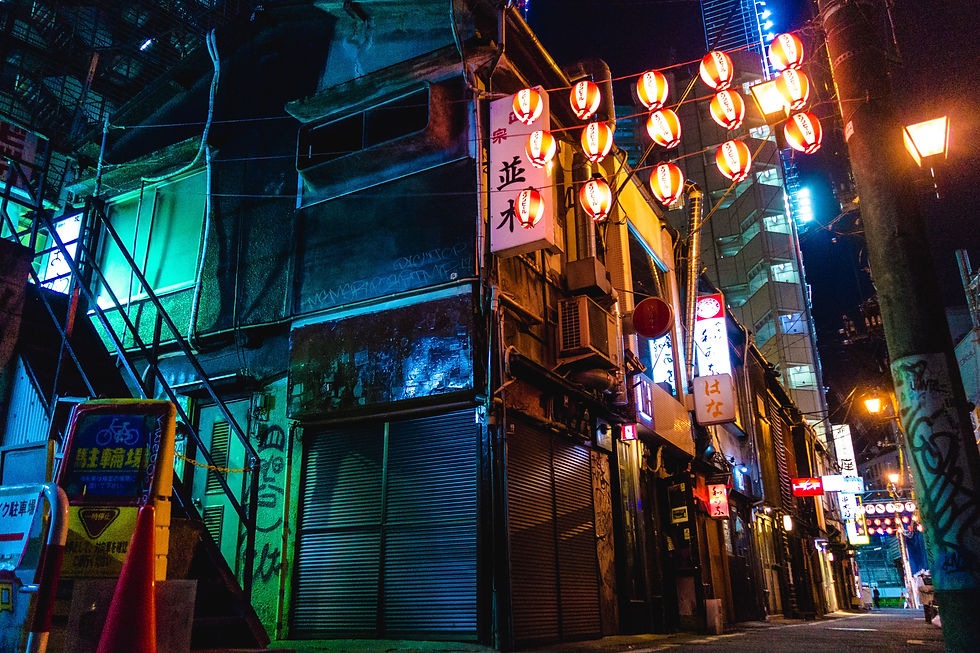
The bars here are genuinely small — some seat only a handful of people — which makes for a more intimate, one-on-one kind of night than the open stalls of Yurakucho. It's a striking contrast: the most modern, overstimulating corner of Tokyo sitting right next to one of its most old-fashioned.

Three alleys, three different nights — Omoide Yokocho for the classic scene, Yurakucho for after-work energy, Nonbei Yokocho for a quieter surprise tucked into Shibuya's chaos. However you spend the evening, the rule is the same: order a few skewers, grab a stool if you can find one, and let the smoke do the rest.
FAQ
What is a yokocho?
A yokocho is a narrow alleyway packed with small, old-school bars and eateries, often just a handful of seats each. They're a holdover from postwar Tokyo and remain some of the best places to experience local nightlife.
Is Omoide Yokocho worth visiting?
Yes — it's touristy, but for good reason. The atmosphere, smoke, and tightly packed stalls still feel genuinely of another era, especially if you duck into one of the smaller counters rather than the busiest ones.
What should I order at a yakitori stall?
Classic skewers like negima (chicken and scallion), tsukune (chicken meatball), and kawa (crispy skin) are safe, delicious starting points. Most stalls also serve cold beer or highballs alongside the food.
Do I need a reservation for these alleys?
No — these are walk-in, first-come-first-served spots. Weeknights tend to be calmer than weekends, and arriving early evening gives you the best shot at a seat.
Is English spoken at these alleys?
Not reliably, especially at smaller stalls. Pointing at what others are eating or at photos on the wall works fine, and most vendors are used to non-Japanese-speaking visitors.
If this kind of alley-hopping, stool-at-a-counter night is your speed, our [Shinjuku Izakaya Tour] runs through similar territory — just with a local guide picking the stops."


