
Hamburg in Tokyo: 3 Japanese Hamburg Steak Restaurants You Need to Try

If you hear “hamburg” in Japan, don't expect a hamburger. Hambāgu (ハンバーグ) is Japan's take on Hamburg steak: a tender patty of ground meat, usually beef, pork, or a combination of the two, mixed with ingredients such as onion, egg, and breadcrumbs. It is typically served on a plate rather than in a bun, often alongside rice and a sauce.

Although it has roots in Western cuisine, Japanese hambāgu has become something distinctly its own. It is one of Japan's best-known examples of yoshoku, the Japanese adaptation of Western-style food. Tokyo, in particular, is home to specialty restaurants that treat this comforting everyday dish with surprising attention to detail.
From Hamburg Steak to Japanese Hambāgu
The story of hambāgu begins with the European Hamburg steak, a ground-meat dish associated with the German city of Hamburg. When Western food began making its way into Japan during the country's modernization in the late 19th century, Japanese cooks started adapting Western dishes to local tastes and ingredients.

One of the earliest documented appearances of a dish resembling modern Japanese hambāgu dates to 1882, when a dish called hamburugu steak was served at a reception celebrating the opening of Akahori Cooking School (Japan's first cooking school!).
Hambāgu gradually became part of Japan's growing yoshoku culture. Western-style restaurants introduced European cooking techniques, and by the late 1890s, dishes resembling hambāgu were appearing on menus in Tokyo.
For many years, however, hambāgu was more commonly associated with restaurants than home cooking. That changed after World War II. Improved refrigeration made ground meat more accessible, while the rise of family restaurants and convenience foods helped turn hambāgu into an affordable and familiar Japanese meal.

Today, Japanese hambāgu is firmly its own dish. The meat is seasoned and prepared differently from traditional Hamburg steak, and the sauces and accompaniments have been adapted to Japanese tastes. It is a perfect example of how Japan has taken an outside influence and developed it into something uniquely Japanese.
Stop 1: Hamburg YOSHI — Charcoal-Grilled Hambāgu in Omotesando
Just a minute from Omotesando Station, Hamburg YOSHI specializes in charcoal-grilled hambāgu with an emphasis on fresh ingredients and quality meat.
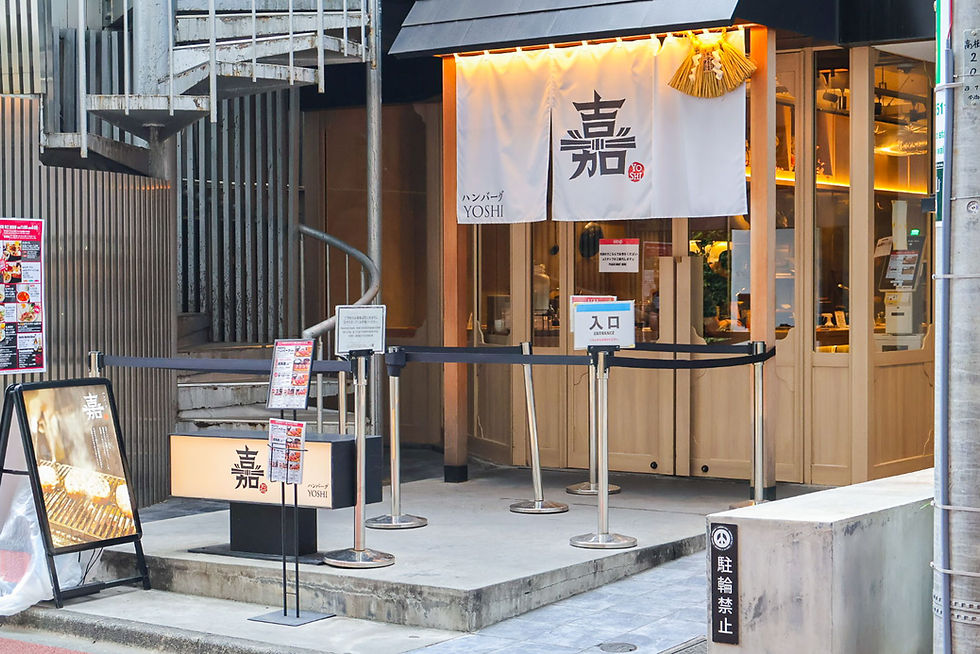
The Omotesando location opened in 2023 as the second Tokyo restaurant of Hamburg YOSHI, following its original restaurant in Jingumae. The chef behind the restaurant has 24 years of experience in yakiniku, bringing a strong understanding of meat and charcoal cooking to the hambāgu.

One of YOSHI's distinguishing features is that the meat is ground in-house each morning before being shaped and cooked over charcoal. The result is a lightly smoky exterior while keeping the center tender and juicy.

The restaurant also takes its rice seriously, using rice selected by a five-star rice master and cooking it in a traditional hagama, or iron rice pot.
Located in Omotesando, YOSHI is an easy stop while exploring Harajuku, Aoyama, and the surrounding shopping streets—and a great introduction to Japanese hambāgu.
Stop 2: Yamamoto no Hamburg — A Convenient Tokyo Favorite
If you're exploring different parts of Tokyo and don't know where you'll be when lunchtime arrives, Yamamoto no Hamburg is an especially convenient choice. The restaurant has multiple locations around Tokyo, including Jiyugaoka and Shibuya, making it easy to fit into almost any itinerary.

The first restaurant opened in Ebisu in 2005 under the name Ore no Hamburg Yamamoto. It originally served a wider range of yoshoku dishes before gradually focusing more heavily on hamburg steak. In 2016, the name was shortened to Yamamoto no Hamburg.

The Jiyugaoka location opened in 2013 and is only a few minutes from the station. Its accessibility, combined with the restaurant's focus on classic Japanese hambāgu, makes it a particularly easy recommendation for travelers.

Rather than trying to reinvent the dish, Yamamoto no Hamburg focuses on what makes hambāgu such a beloved Japanese comfort food: a satisfying meat patty, rice, sauce, and a casual atmosphere.
If you want to try a well-established Tokyo hambāgu restaurant without building your entire day around it, this is a great option.
Stop 3: Hamburg and Hamburg — A Modern Beef-Focused Take in Shibuya
Located near Miyashita Park in Shibuya, Hamburg and Hamburg offers a more contemporary interpretation of Japanese hambāgu.

The restaurant originally opened in Kagurazaka in 2022 before moving to Shibuya and reopening in 2023. It is operated by Guernica, a company that raises its own Black Angus cattle in the United States, giving the restaurant a particular focus on beef quality.

Rather than using extremely fine ground meat, Hamburg and Hamburg uses coarsely ground Black Angus beef. This creates a meatier texture and allows the beef itself to stand out. The restaurant also offers an unusual amount of customization, with the company stating that diners can create more than 66 different flavor combinations.

Its location makes it an easy addition to a day around Shibuya and Miyashita Park, while the modern approach gives visitors a chance to experience how hambāgu continues to evolve.
Why You Should Try Hambāgu in Japan
Japanese hambāgu is more than a Western dish that happened to become popular in Japan. Over more than a century, it has been adapted, refined, and transformed into a Japanese comfort food in its own right.

That makes it well worth adding to your Japan food list. Unlike a hamburger, hambāgu puts the focus entirely on the meat, texture, sauce, and rice. It is familiar enough to feel approachable, but different enough to be a genuinely Japanese food experience.
And Tokyo makes it easy to explore that difference. Whether you're looking for charcoal-grilled hambāgu in Omotesando, a reliable restaurant with locations throughout the city, or a modern beef-focused interpretation in Shibuya, these three restaurants are a delicious place to start.


